
Formule 1
Greffe de Cheveux FUE
Technique Saphir
500 à 1 000 greffons
Intervention sur une journée
2 000 €
Technique CHOÏ
2 750 €

Hairline Transplant
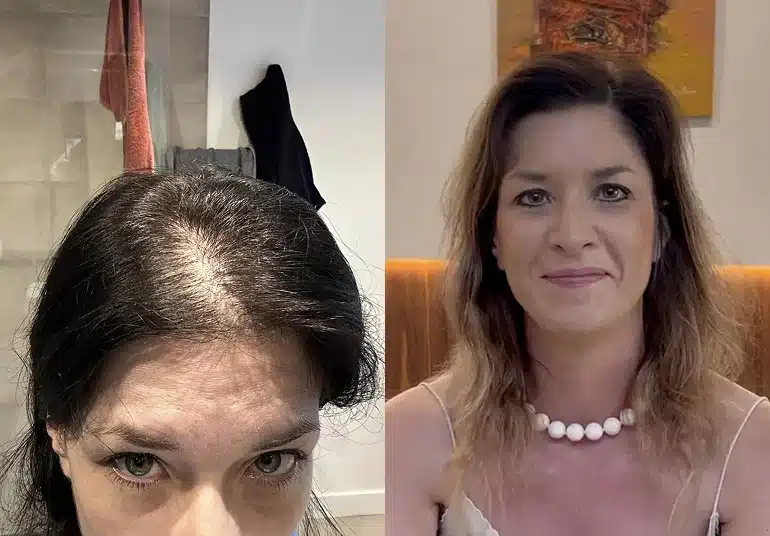
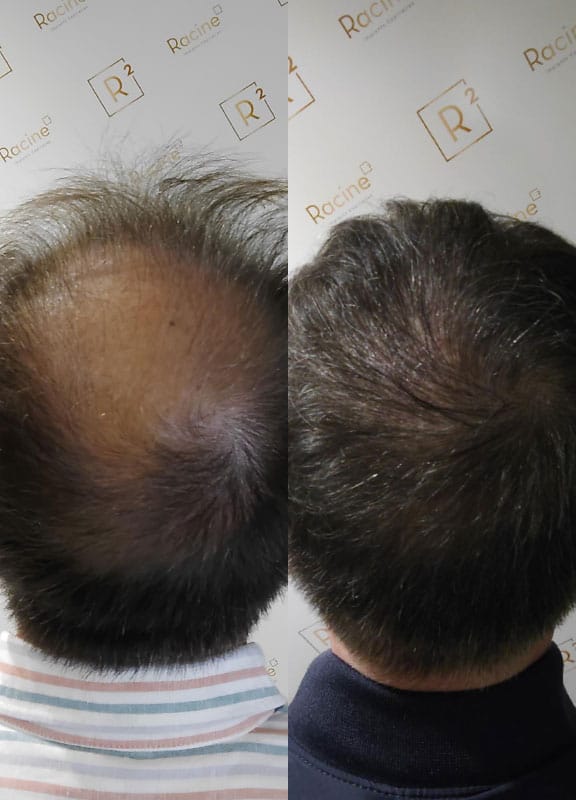
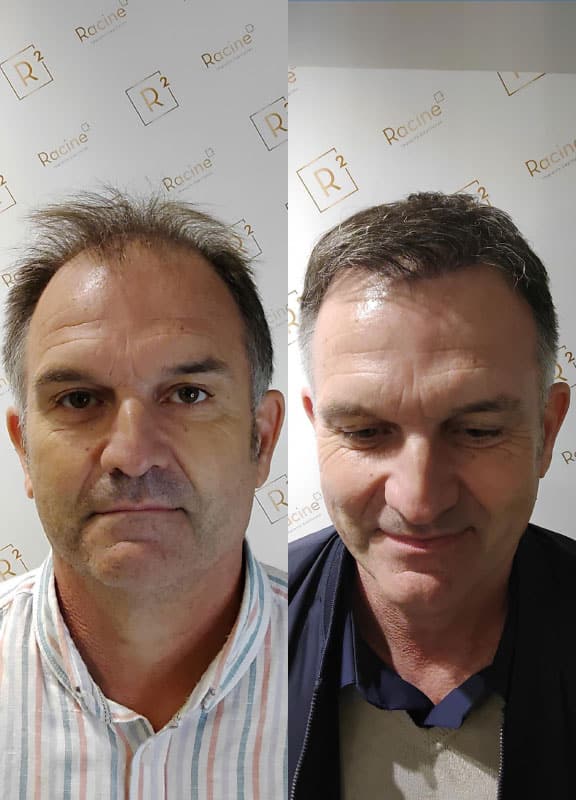
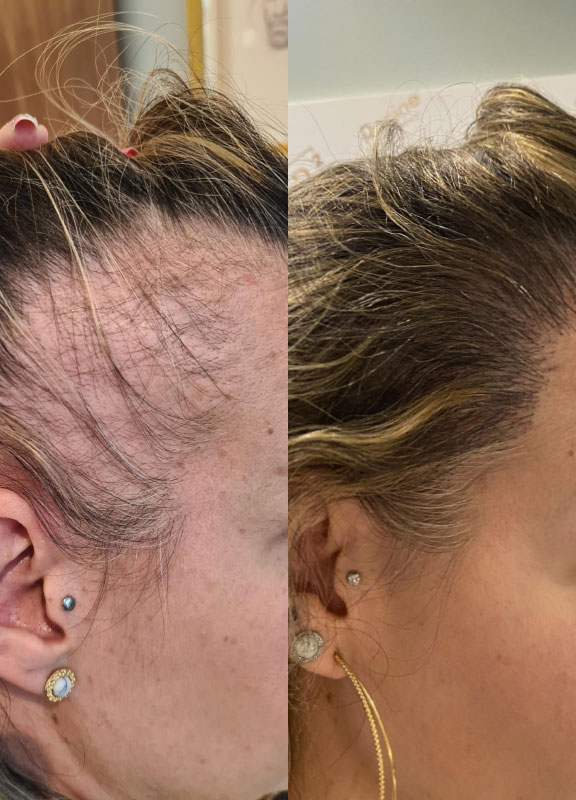
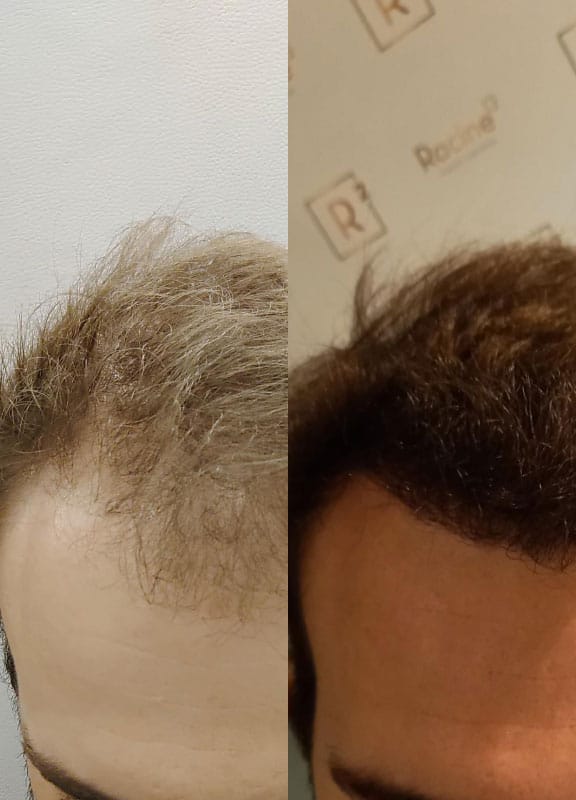
Frontal hairline transplant is an aesthetic medicine procedure that corrects temporal recesses and reshapes the hairline. This hair transplantation technique delivers natural, long-lasting results for individuals experiencing frontal hairline recession. Performed by a surgeon, at Racine² it uses the FUE method for precise graft harvesting. Implantation is done via Sapphird blade or CHOÏ stylet incisions.

FUE Transplant with Sapphire blade or CHOÏ

A natural hairline

Human follow-up over 12 months.

+5.000 satisfied patients
Confidence retrieved
100% dedicated to haircare
Quality maxi, Prices mini
Deeply human
Attentive care, painless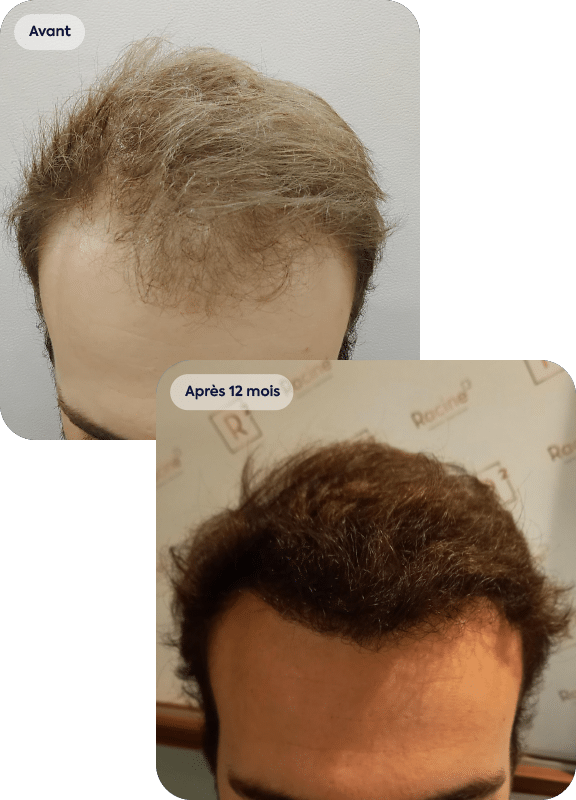
A hairline transplant is a procedure that corrects hair growth at the front of the head. This technique involves taking hair grafts from a donor area, usually located at the back of the head, and implanting them along the hairline. The goal is to recreate a natural and harmonious hairline, taking into account the patient’s facial structure.
The FUE (Follicular Unit Extraction) method is the preferred technique for this type of transplant. It allows for the extraction of each follicular unit individually, without leaving any visible scars. Implantation can then be performed using a sapphire blade or a Choi pen, depending on the patient’s needs and the desired density. This procedure requires great precision to achieve an aesthetically pleasing and natural result, as the hairline is a highly visible area of the face.
The cost of a hairline transplant in Paris varies depending on the number of grafts required and the technique used. The cost is generally calculated based on the number of grafts implanted, which depends on the extent of hair loss at the front of the scalp and the desired density.
On average, between 1,000 and 2,500 grafts may be needed to reshape a hairline. The implantation method, whether using the FUE technique with shaving or FUE without shaving, also influences the price. At Racine Carrée, we offer transparent pricing tailored to each type of procedure.
Formule 1
Greffe de Cheveux FUE
Technique Saphir
500 à 1 000 greffons
Intervention sur une journée
2 000 €
Technique CHOÏ
2 750 €
Formule 2
Greffe de Cheveux FUE
Technique Saphir
1 100 à 1 900 greffons
Intervention sur une journée
2 750 €
Technique CHOÏ
3 500€
Formule 3
Greffe de Cheveux FUE
Technique Saphir
2 000 à 3 000 greffons
Intervention sur une journée
3 500 €
Technique CHOÏ
4 250€
Formule 4
Greffe de Cheveux FUE
Technique Saphir
3 100 greffons et plus
Intervention sur une journée
4 250 €
To correct a hairline considered too high, patients have two main options: surgical forehead reduction or hairline transplantation. These two cosmetic procedures address different issues and each has its own advantages.
Forehead reduction surgery involves removing a strip of skin from the forehead to lower the hairline. This technique is particularly suitable for people with a naturally high forehead and no hair loss. The procedure leaves a scar that is usually concealed by the hair.
Hair transplantation, on the other hand, reshapes the hairline by implanting hair taken from the patient’s own scalp. This method is ideal for correcting receding temples and bald patches. It offers a more natural result because it uses the patient’s own hair and leaves no visible scar. The choice between these two techniques depends on many factors, such as facial anatomy, scalp condition, and the patient’s expectations. A precise diagnosis by a specialist physician determines the most suitable solution for each individual case.
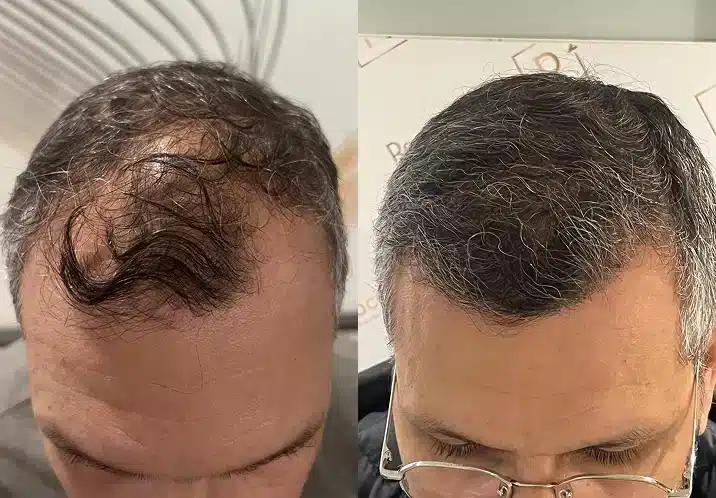
After a hairline transplant, the final results are visible after 10 to 12 months. During the first few weeks, some shedding of the transplanted hairs, called “shock loss,” is normal and should not worry the patient. The implants generally begin to grow from the third month onward.
To optimize results, certain precautions must be taken after the procedure. It is essential to strictly follow the doctor’s instructions regarding scalp care. Avoid touching or scratching the transplanted area for the first few days, refrain from bathing or engaging in strenuous exercise for the first two weeks, and protect yourself from the sun. The local anesthetic used during the procedure generally does not have major side effects, but slight sensitivity may persist for a few days.
The final result depends on many factors, including the quality of the grafts, the implantation technique, and adherence to post-operative instructions. Regular follow-up appointments with the doctor ensure the transplant is progressing well and allow for adjustments to any additional treatments necessary to maintain the achieved hair density.
Hairline reduction or temple correction is a procedure that affects both men and women. Several factors may lead to considering a hair transplant in this area:
In most cases, this hair loss is linked to alopecia, often androgenetic (hereditary) in men, but also to other causes such as alopecia areata, an autoimmune disorder.
To assess the suitability of a hair transplant along the hairline, professionals generally rely on the Norwood scale (for men) or the Ludwig scale (for women). These tools allow them to determine the stage of hair loss and anticipate its progression.
As a general rule, patients with moderate hair loss (stages 3 to 4 on the Norwood scale) are good candidates for a hairline transplant. Beyond this stage, when the loss is too advanced (stages 5 to 6), the procedure may be more complex or require aesthetic compromises.
The success of a hair transplant depends closely on the density and quality of the hair available at the back of the head (the donor area). Insufficient density can limit the ability to recreate a dense and natural-looking hairline.
Younger patients, who have not yet experienced significant hair loss across their entire scalp, often have more flexibility.
Ongoing hair loss can compromise the results of a frontal hair transplant. Therefore, it is generally recommended to stabilize alopecia before any procedure.
If the transplant is performed too early, the loss of natural hair can unbalance the final result and necessitate future touch-ups. A precise medical diagnosis is therefore essential to choose the right time.
All our transplantation



Le meilleur de la greffe FUE devient accessible à tous. Vivez la révolution capillaire made in France.
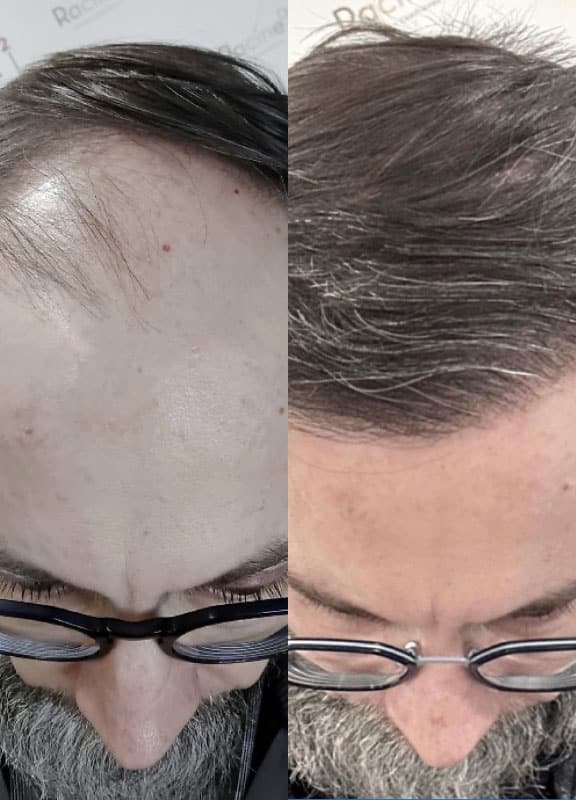
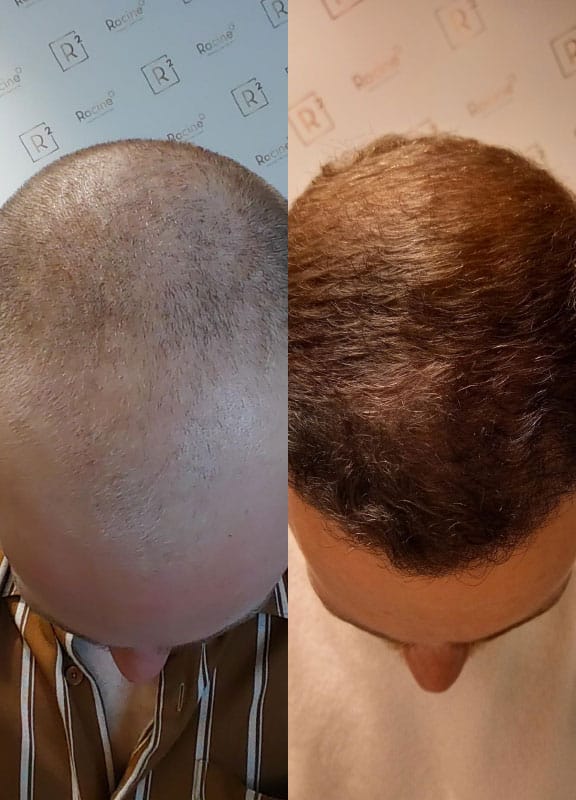

La greffe redessine votre ligne frontale avec vos propres cheveux, tandis que la réduction chirurgicale retire une partie de la peau du front.
La greffe capillaire implante des follicules prélevés sur votre cuir chevelu pour créer une nouvelle ligne frontale, sans cicatrice visible. La réduction du front, elle, laisse une cicatrice généralement cachée sous les cheveux.
Entre 1000 et 2500 greffons sont généralement nécessaires pour une ligne frontale naturelle.
Le nombre de cheveux exact dépend de l’étendue des golfes à corriger et de la densité souhaitée. Chaque cas est unique et nécessite un diagnostic personnalisé pour déterminer le nombre précis de greffons à implanter.
Absolument, une greffe bien réalisée offre un résultat parfaitement naturel et quasi indétectable.
La clé réside dans l’implantation précise des greffons selon un angle et une direction qui respectent la croissance naturelle des cheveux. L’expertise du médecin est essentielle pour prendre en compte la morphologie du visage et créer une ligne frontale harmonieuse.
Oui, une transplantation capillaire est une solution efficace pour traiter la perte de cheveux localisée au niveau de la ligne capillaire.
Elle permet de redessiner la ligne frontale et d’obtenir une ligne plus harmonieuse grâce à l’implantation de greffons prélevés sur la zone donneuse. Cette technique s’adresse notamment aux personnes souffrant d’alopécie androgénétique ou d’un recul progressif du haut du crâne.
Oui, l’acide hyaluronique peut être utilisé en mésothérapie
Il est capable d’améliorer l’hydratation du cuir chevelu, favoriser la repousse et maintenir la qualité des cheveux existants après une implantation capillaire. Ce soin est souvent recommandé en complément d’une greffe de cheveux pour maximiser les résultats, notamment en cas d’alopécie androgénétique ou de terrain carencé.
Si, en plus du recul de la ligne frontale, le haut du crâne montre également des signes d’alopécie, une approche globale est nécessaire.
Le chirurgien peut proposer d’étendre la transplantation capillaire à cette zone ou de planifier plusieurs sessions selon la densité de la zone donneuse. Une consultation gratuite permet de poser un diagnostic précis et de déterminer si une greffe capillaire ou des traitements complémentaires sont recommandés.