

5 Common Myths About Hair Transplantation
Hair transplantation still raises many questions—and quite a few misconceptions. Should you be concerned if the transplanted hair falls out? Is one procedure enough to restore high density? And is a successful transplant really measured by the number of grafts implanted?
Behind these questions lie some firmly established beliefs that do not always reflect reality. To better understand the procedure and what truly makes a difference to its outcome, let’s separate fact from fiction and debunk 5 common myths about hair transplantation.

Hair can fall out a few weeks after the procedure

One hair transplant is enough to restore very high density

Hair transplantation often produces an unnatural-looking result

Hair transplantation is only for men

The more grafts are harvested, the better the result
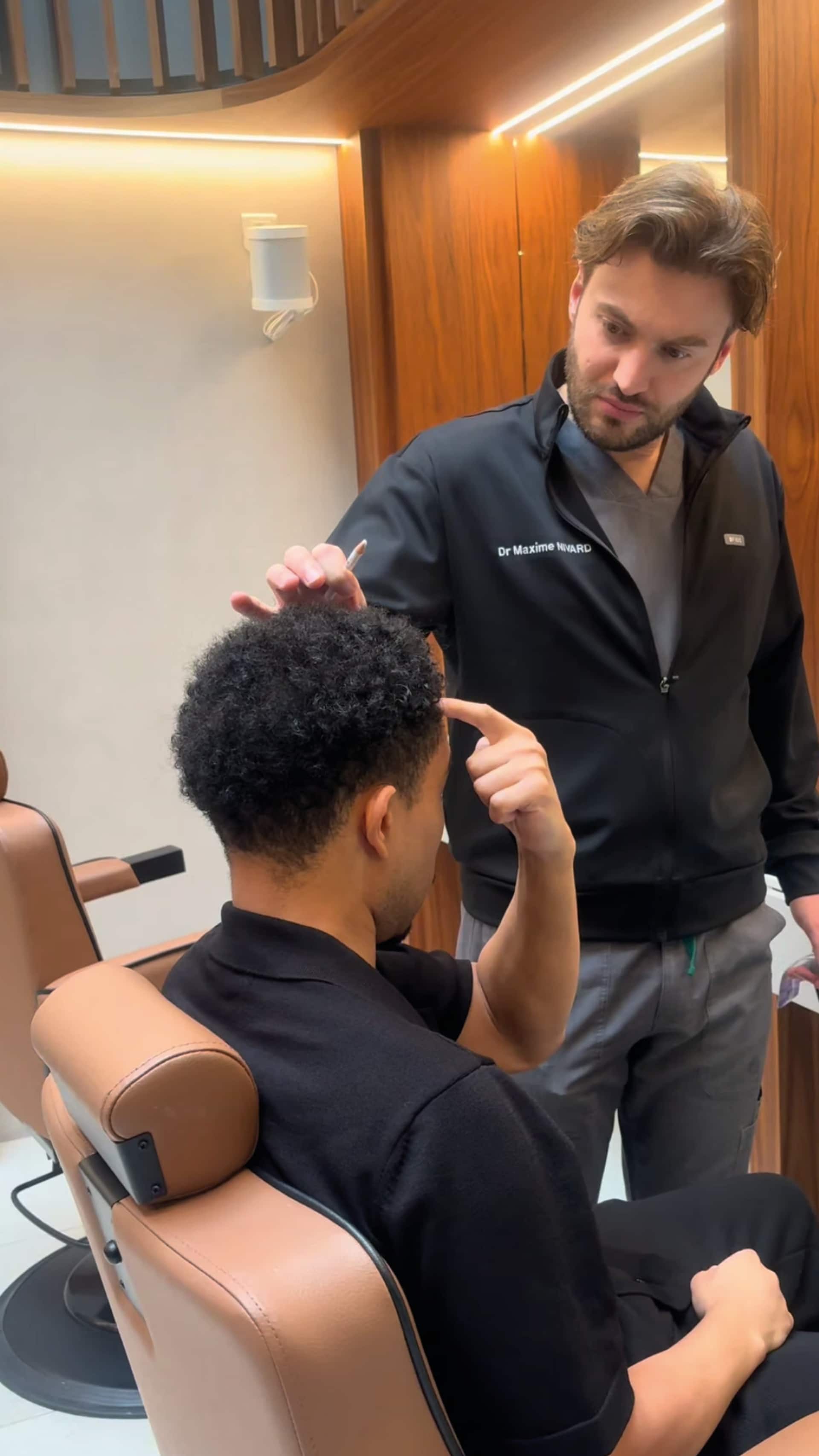

Hair can fall out a few weeks after the procedure: TRUE
Seeing your hair fall out after a transplant can be quite unsettling. However, this shedding is generally completely normal. In the weeks following the procedure, some of the transplanted hair may fall out before the follicles enter a new phase of their growth cycle.
This does not mean that the grafts have been lost. The follicles remain implanted beneath the skin, and new hair gradually begins to grow over the following months. The results of a hair transplant therefore cannot be assessed just a few weeks after the procedure: they develop over time.
At Racine Carrée, post-transplant follow-up is designed to support patients throughout this process and answer any questions that may arise during the different stages of regrowth. Because when it comes to hair, a little patience is sometimes required!
One hair transplant is enough to restore very high density – FALSE
A hair transplant can help restore good density, but a single procedure is not always enough to achieve the desired result. Every patient has a different hair capital, and the number of available grafts depends in particular on the quality of the donor area, the size of the area to be treated, and the desired density.
For some patients, a single procedure may be enough to achieve a harmonious result. For others, a second transplant may eventually be considered depending on their needs and how their hair loss progresses. The goal is always to work with the available resources to achieve a natural-looking result, without seeking unrealistic density.
Hair transplantation often produces an unnatural-looking result – FALSE
An overly straight hairline, perfectly aligned hairs, a visible transition… Older images of hair transplantation have left their mark on people’s minds. However, modern techniques now make it possible to plan and perform implantation with much greater precision.
The natural appearance of a transplant depends on many details. The hairline must be adapted to the patient’s face, while the angle, direction, and distribution of the implanted hairs should reproduce their natural growth pattern as closely as possible. It is therefore not simply a matter of filling in a thinning area, but of considering how each graft will integrate with the rest of the hair.
At Racine Carrée, achieving a natural-looking result is an integral part of the preparation process. The hairline is specifically designed with the doctor, taking into account the patient’s facial structure, existing hair, and goals. After all, a successful hair transplant is often one that nobody notices.
Hair transplantation is only for men – FALSE
Although hair transplantation is still often associated with men, women can also experience hair loss. Androgenetic alopecia, certain forms of traction alopecia, and loss of hair density may lead patients to seek medical advice and, in some cases, consider a transplant.
However, not all types of hair loss can be treated with a transplant. Certain conditions, such as alopecia areata, require specific management. Before considering a transplant, it is therefore essential to accurately identify the cause of hair loss and determine whether transplantation is an appropriate solution.
At Racine Carrée, both women and men receive an assessment to analyse their individual situation and hair capital before the different treatment options are determined. Because before discussing a transplant, the first step is always to understand why the hair is falling out.
The more grafts are harvested, the better the result – FALSE: preserving the donor area is essential
The equation may seem simple: the more grafts harvested, the denser the result. In practice, however, it is a little more complex. The donor area, generally located at the back and sides of the scalp, contains a limited number of usable follicles and must therefore be preserved.
During an FUE transplant, harvested follicles do not grow back in their original location. Excessive harvesting could therefore visibly thin the donor area and limit the options for a future procedure if hair loss continues to progress.
At Racine Carrée, the number of grafts is determined according to the area to be treated, the available resources, and the desired outcome. The goal is not to harvest as many grafts as possible, but to make the best use of the patient’s hair capital while considering its long-term evolution.
CONCLUSION
A hair transplant is therefore about much more than the number of grafts or a promise of density. Each treatment plan depends on the patient’s hair, the donor area, and the progression of hair loss. At Racine Carrée, the hair assessment makes it possible to evaluate these different factors and develop a treatment plan tailored to each patient. The goal: to achieve a natural-looking result while preserving the patient’s hair capital over the long term.
Questions about your hair health?
Our advisors are here to guide you through our range of hair care treatments.



Already a client?
See you in your patient area
Your appointments, documents, instructions, and tutorial videos, all in one place.